
I am on this list, at 22. I sell SEO training and a paid community, so I compete with roughly a third of the people below for the same attention and the same money.
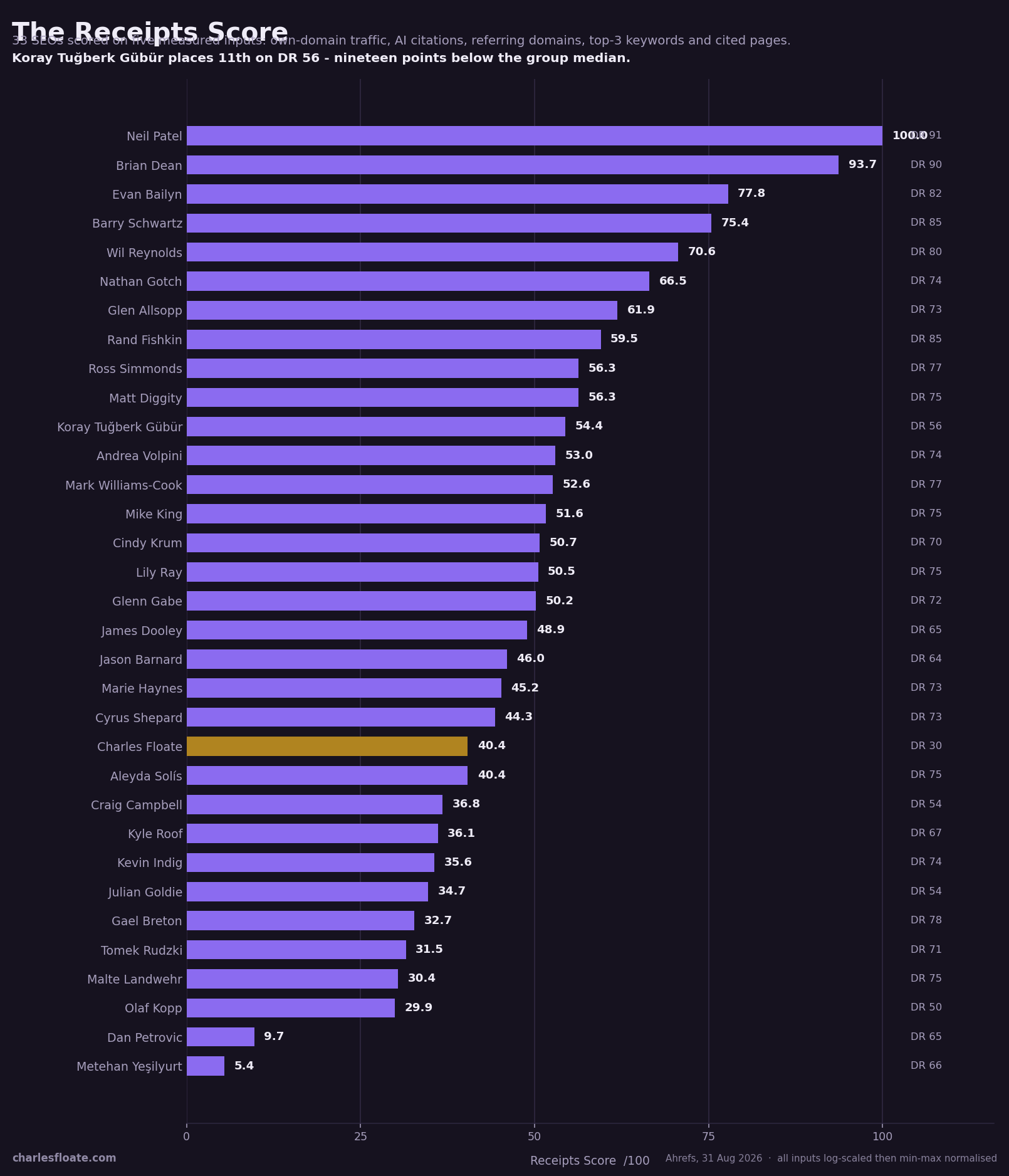
Which is why the score is a published formula rather than my opinion. Five measured inputs, one line of maths, printed in full so you can re-run it and tell me I'm wrong. I score 40.4. Eleven people I would happily pay to learn from score under me and I'll explain why that does not mean what it looks like.
Every "top SEO experts" list works the same way. Somebody who wants links writes down twenty names, the twenty names share it because their name is on it, and the list ranks because twenty people with decent domains just linked to it.
Nobody checks anything. Here's how I know.
Feedspot's SEO influencer ranking was last modified on 19 August 2026. Two weeks ago, as I write this. It ranks Bill Slawski at number 13, with 58.7K followers and a live job title.
The same list has Tristam Jarman at number one with 865 followers, ranked above Neil Patel and his 476,000. Whatever that list is sorted by, it is not influence, and it is not maintained by a person who reads it.
It gets worse. Bruce Clay died in May 2026. He was one of the genuine founders of the discipline, he has been publicly mourned across every trade publication in the industry, and he is still being recommended as a person to follow on "best SEO experts of 2026" listicles published after his death.
This is the state of the category. So I rebuilt my own version from scratch, with a formula instead of a favour list.
Three things are true about almost every "top SEO experts" page ranking in Google right now:
I am on at least two of those recycled lists. I did not write them and I do not control them, and I am not going to sit here and pretend my appearances are the pure meritocratic exception while everyone else's are compromised.
If you found me through one of those pages, you should apply the same discount to my name that I have just asked you to apply to everyone else's. The correct response to "Charles Floate appears on four top SEO expert lists" is not "he must be good", it is "he must be well distributed". Those are different claims and only one of them is flattering.
So here is the version where distribution counts for nothing.
Five inputs, all pulled from Ahrefs on 31 August 2026, all reproducible in about ten minutes. Every input is log-scaled first, because the difference between 300 and 3,000 monthly visits matters far more than the difference between 300,000 and 302,000, then min-max normalised across the 33 people so the best in each category scores full marks.
The formula in one line, so nobody has to guess:
Score = 30·norm(log traffic) + 30·norm(log citations) + 15·norm(log ref domains) + 15·norm(log top-3 keywords) + 10·norm(log cited pages)
| # | Name | Primary domain | Score | DR | Ref dom | Traffic/mo | Top-3 kw | AI cites |
|---|---|---|---|---|---|---|---|---|
| 1 | Neil Patel | neilpatel.com | 100.0 | 91 | 81,438 | 347,828 | 2,392 | 12,438 |
| 2 | Brian Dean | backlinko.com | 93.7 | 90 | 58,567 | 319,747 | 1,498 | 7,619 |
| 3 | Evan Bailyn | firstpagesage.com | 77.8 | 82 | 9,452 | 69,205 | 1,174 | 1,875 |
| 4 | Barry Schwartz | seroundtable.com | 75.4 | 85 | 21,479 | 21,696 | 943 | 946 |
| 5 | Wil Reynolds | seerinteractive.com | 70.6 | 80 | 9,776 | 13,163 | 610 | 1,249 |
| 6 | Nathan Gotch | rankability.com | 66.5 | 74 | 3,968 | 29,097 | 313 | 1,064 |
| 7 | Glen Allsopp | detailed.com | 61.9 | 73 | 2,936 | 10,278 | 418 | 821 |
| 8 | Rand Fishkin | sparktoro.com | 59.5 | 85 | 18,846 | 6,916 | 125 | 195 |
| 9 | Ross Simmonds | foundationinc.co | 56.3 | 77 | 5,331 | 2,302 | 174 | 342 |
| 10 | Matt Diggity | diggitymarketing.com | 56.3 | 75 | 4,411 | 653 | 51 | 1,307 |
| 11 | Koray Tuğberk Gübür | holisticseo.digital | 54.4 | 56 | 1,459 | 1,625 | 175 | 741 |
| 12 | Andrea Volpini | wordlift.io | 53.0 | 74 | 3,205 | 3,299 | 86 | 324 |
| 13 | Mark Williams-Cook | alsoasked.com | 52.6 | 77 | 4,644 | 8,941 | 71 | 183 |
| 14 | Mike King | ipullrank.com | 51.6 | 75 | 5,353 | 2,880 | 80 | 173 |
| 15 | Cindy Krum | mobilemoxie.com | 50.7 | 70 | 1,445 | 18,787 | 81 | 131 |
| 16 | Lily Ray | amsive.com | 50.5 | 75 | 3,354 | 5,626 | 87 | 120 |
| 17 | Glenn Gabe | gsqi.com | 50.2 | 72 | 2,529 | 1,973 | 177 | 184 |
| 18 | James Dooley | fatrank.com | 48.9 | 65 | 4,122 | 894 | 42 | 269 |
| 19 | Jason Barnard | kalicube.com | 46.0 | 64 | 1,252 | 1,865 | 96 | 159 |
| 20 | Marie Haynes | mariehaynes.com | 45.2 | 73 | 2,800 | 1,340 | 84 | 109 |
| 21 | Cyrus Shepard | zyppy.com | 44.3 | 73 | 2,403 | 1,670 | 73 | 100 |
| 22 | Charles Floate | charlesfloate.com | 40.4 | 30 | 672 | 2,649 | 51 | 118 |
| 23 | Aleyda Solís | aleydasolis.com | 40.4 | 75 | 3,363 | 1,252 | 39 | 47 |
| 24 | Craig Campbell | craigcampbellseo.com | 36.8 | 54 | 1,539 | 330 | 14 | 108 |
| 25 | Kyle Roof | pageoptimizer.pro | 36.1 | 67 | 1,968 | 2,329 | 25 | 24 |
| 26 | Kevin Indig | growth-memo.com | 35.6 | 74 | 2,410 | 843 | 23 | 33 |
| 27 | Julian Goldie | juliangoldie.com | 34.7 | 54 | 1,216 | 460 | 9 | 74 |
| 28 | Gael Breton | authorityhacker.com | 32.7 | 78 | 7,054 | 302 | 13 | 22 |
| 29 | Tomek Rudzki | ziptie.dev | 31.5 | 71 | 1,860 | 480 | 9 | 28 |
| 30 | Malte Landwehr | peec.ai | 30.4 | 75 | 3,906 | 2,076 | 5 | 9 |
| 31 | Olaf Kopp | kopp-online-marketing.com | 29.9 | 50 | 751 | 265 | 18 | 44 |
| 32 | Dan Petrovic | dejanmarketing.com | 9.7 | 65 | 1,116 | 12 | 2 | 4 |
| 33 | Metehan Yeşilyurt | metehan.ai | 5.4 | 66 | 903 | 0 | 0 | 14 |
Look at the bottom two rows. Dan Petrovic at 32nd. Metehan Yeşilyurt at 33rd.
Petrovic is one of maybe three people alive doing genuine mechanistic interpretability work on search models. He trains his own models to find out how retrieval actually behaves. If I had one technical question about how an engine decides what to surface, I would ask him before I asked anyone else on this page, including the people in the top five.
He scores 9.7 out of 100.
The reason is not that the formula is broken. The reason is that the formula measures a website, and Petrovic does not use his website. His findings go out as LinkedIn posts and X threads and conference talks. dejanmarketing.com gets 12 organic visits a month because he has not asked it to get more.
So here is the rule for reading any scoreboard, mine included: a low score is a fact about the thing being measured, not a verdict on the person. I measured domains. Anyone whose work lives on other people's platforms scores badly and always will.
What the score IS good for: catching the opposite error. If someone has spent three years telling you they are a top SEO expert and their own domain gets 300 visits and 4 citations, that is now a question they have to answer.
The same caveat applies to the other end. Neil Patel scoring 100 tells you he runs the largest SEO content operation on earth. It does not tell you he would be your best hire.
Maximum score, and the least useful entry on the page. Patel runs an industrial content and agency operation and the numbers reflect industrial scale, not individual craft. 81,438 referring domains is more than the next two people combined.
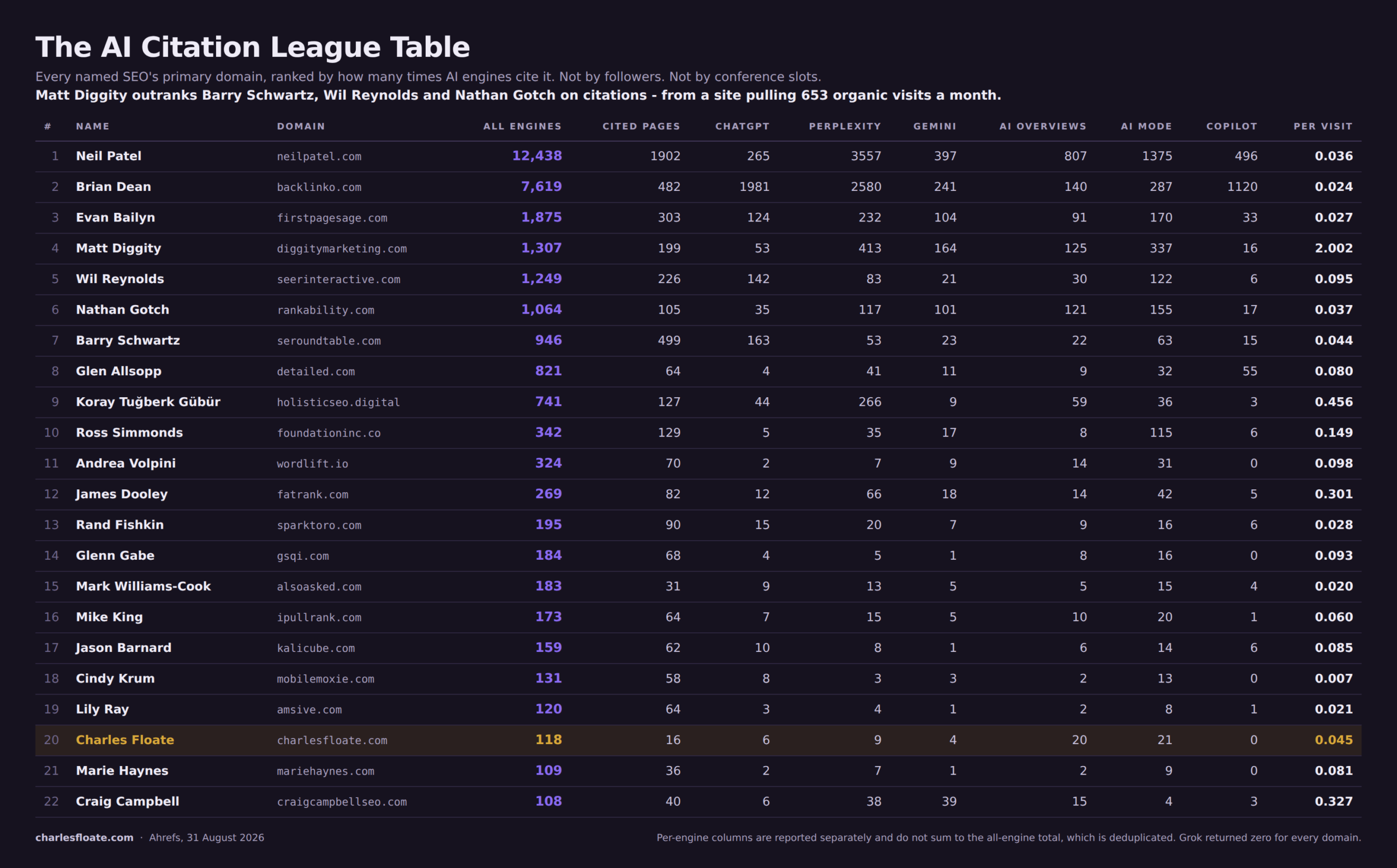
Worth knowing: he is also first on AI citations by a factor of 1.6 over second place. Whatever you think of the content, the machines are reading it constantly.
Twenty-three years of publishing search news, every day, without missing. 499 distinct cited pages - the second-highest count in the set, behind only Neil Patel's 1,902 - which is what two decades of consistent daily archive does to a machine-readable footprint.
If you only follow one person in this industry, it is still him, and it has been him since about 2004.
The highest-scoring agency in the top ten that got there on published research rather than publishing volume. Seer gives away work most agencies would gate, and 226 cited pages is the return on that.
Publishes rarely and lands hard every time. Detailed's work on which handful of companies quietly own the SERPs is the kind of research that changes how people see the industry, and it earns him 821 citations off 64 cited pages - the second-highest citations-per-page ratio in the set at 12.8.
Proof that output frequency is not the variable people think it is.
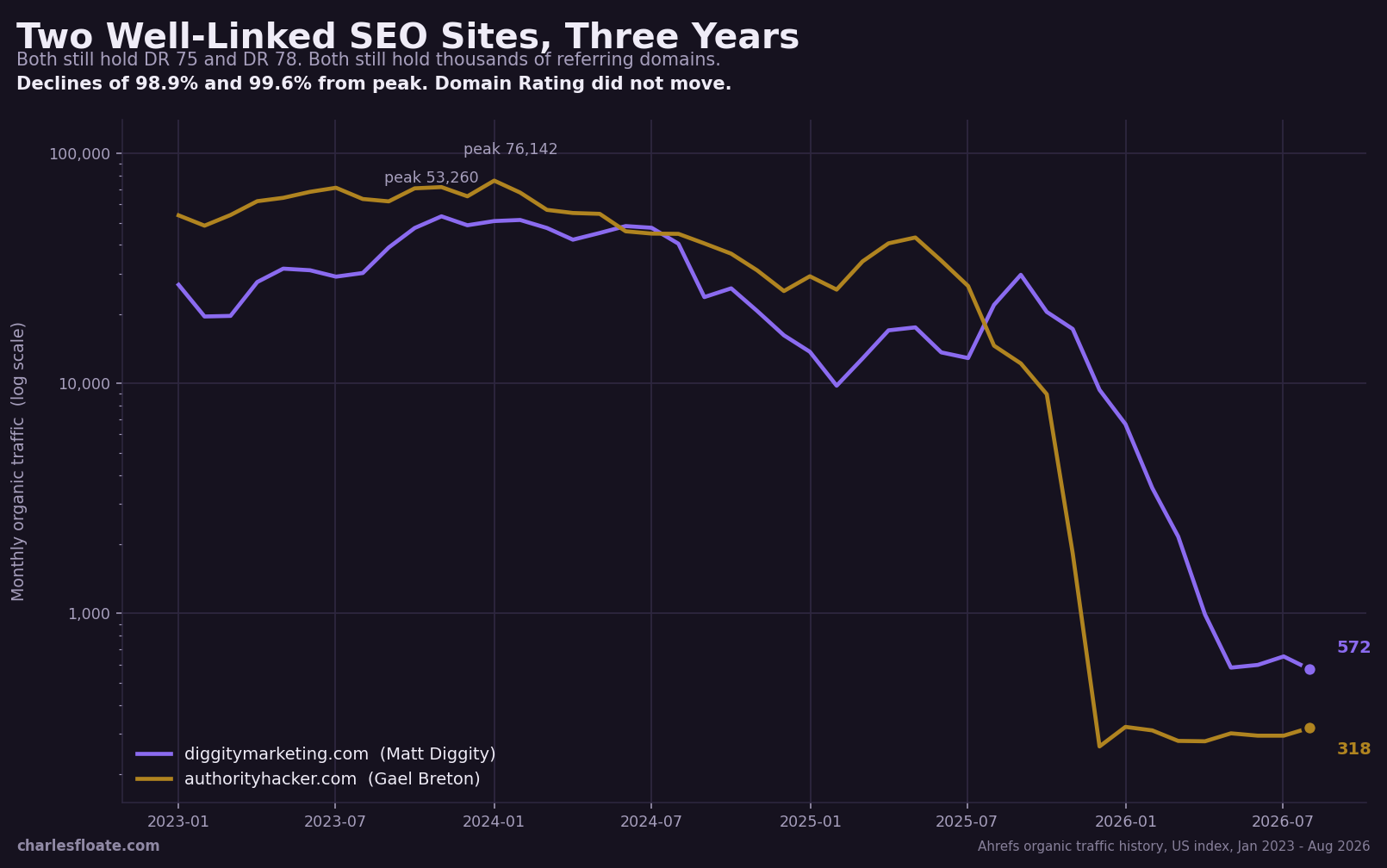
The most interesting row on the table. 653 organic visits, down from a peak of 53,260 in November 2023 - and 1,307 AI citations, fourth overall, ahead of Barry Schwartz.
Diggity's tested-affiliate-tactics archive is being treated by the engines as a reference work at the same time Google appears to have stopped sending it people. I do not have a tidy explanation. I have the two numbers and the fact that they point in opposite directions.
The most efficient entry on the board. DR 56 - eighteen points below the group median - and he still lands 11th, ahead of Mike King, Lily Ray, Cyrus Shepard and Aleyda Solís, all of whom have substantially more authority to work with.
His semantic and topical authority frameworks are hard reading and unusually rigorous, and the engines quote them constantly. 266 Perplexity citations, second only to Matt Diggity's 413 among individuals.
Did more than any single person to make the Google leak usable, and his relevance engineering work is the most technically ambitious thing being published in the field right now.
Scores 14th because the formula measures a domain and his best material lands as talks, decks and long PDFs that other sites then summarise. The engines cite the summarisers. That is a fact about publishing formats, not about Mike King.
177 keywords in the top three off 1,973 monthly visits tells you exactly what Glenn does: he owns a very large number of very specific algorithm-update queries that almost nobody searches, and he owns them completely. When a core update lands he is the first coherent read available, every time.
Fourth-highest citation ratio in the whole set. FatRank is built as a definitions-and-lists property, and definitions are the single most liftable content format that exists. Whether that was designed for AI retrieval or is an accident of an old lead-gen playbook, it works.
Tied with me, on a domain 45 DR points stronger than mine, and the gap between her standing in this industry and this score is the largest on the page after Petrovic's.
The cause is the same structural one: SEOFOMO is the product, the newsletter is where the work lives, and a newsletter is not a crawlable archive. She has probably taught more working SEOs than anyone else on this list. The formula cannot see any of it.
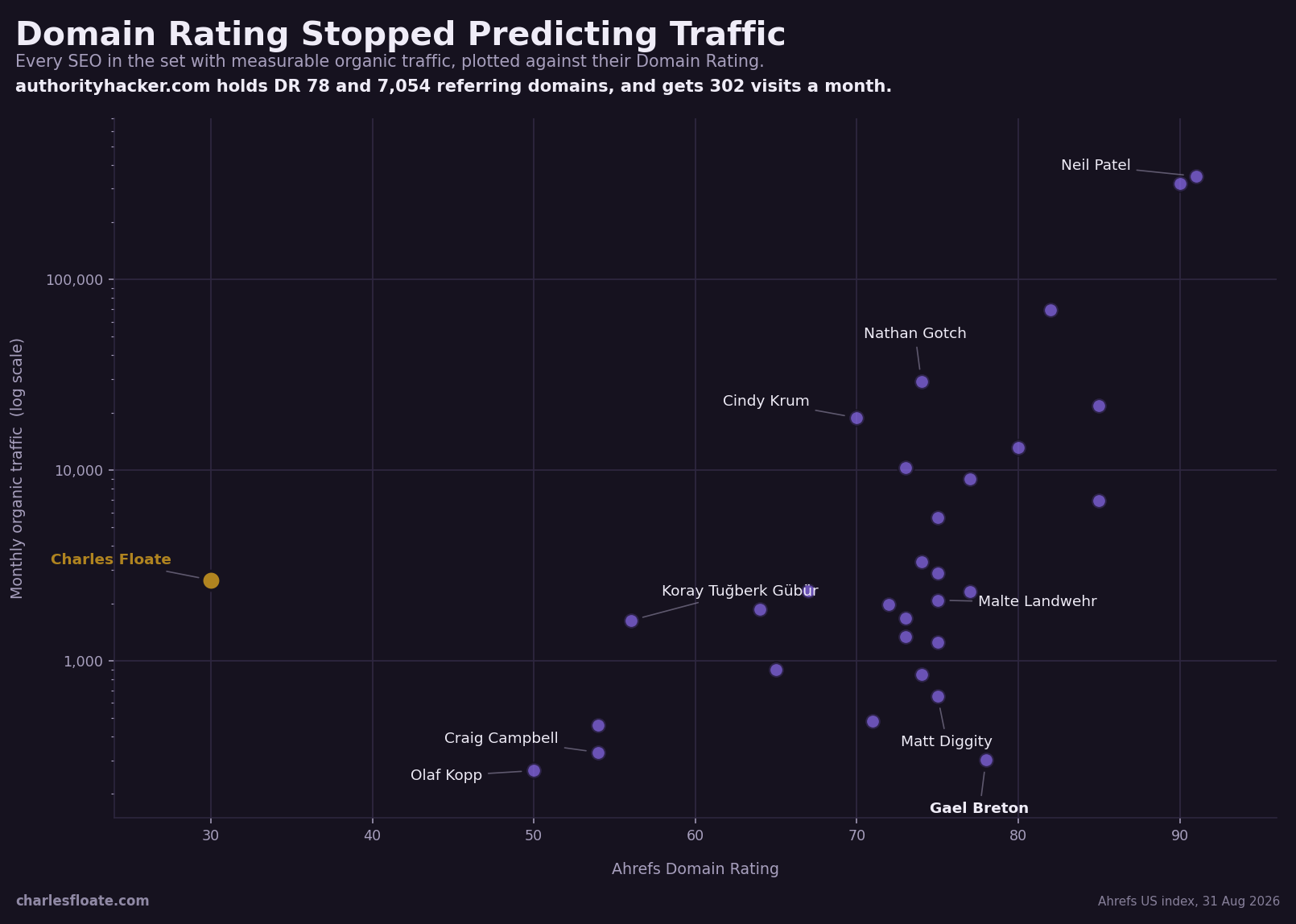
Included because it is the starkest before-and-after on the page. DR 78 and 7,054 referring domains - seventh-highest authority in this entire group - producing 302 organic visits and 22 AI citations.
authorityhacker.com did 76,142 visits in January 2024. It fell to 1,825 in November 2025 and 264 the month after, and has flatlined around 300 ever since. That is a 99.6% decline, and it happened in one quarter. It is not a knock on the man. It is the clearest single illustration of why "look at their DR" stopped being a useful question.
Check before you cite. All of these still appear on lists published or updated in 2026:
None of that is a gotcha. People die and people move on. The point is that a list nobody has read in four years is not research, and there are a lot of them ranking above this one right now.
I am 22nd with 40.4, tied with Aleyda Solís, on DR 30 - the lowest domain rating of all 33 by twenty points. My referring domain count, 672, is the smallest in the set. I get there on traffic efficiency and a decent AI Overview footprint, and I would not have made the top half of this table five years ago when the site was bigger and doing less.
What I will not do is score my own community on my own rubric, because that is the trick this whole page exists to complain about. Here it is, described plainly, and you can weigh it yourself:
My paid community. Weekly live call, the tool and repo stack I actually use, and the tests I cannot publish in public - including a live experiment putting real money through 13 PR vendors to see which ones buy AI citations. Operators only, priced accordingly.
If you'd rather not pay me anything: Barry Schwartz's daily feed, Glenn Gabe on updates, Seer's published research and Koray's back catalogue will cost you nothing and cover most of it. That is a genuine recommendation, not a humility performance.
There isn't one, and any page that gives you a single name is selling something. On measurable output - own-domain traffic, earned links, AI citations - Neil Patel and Brian Dean lead, but both run large content operations rather than practising individually. Among individual practitioners, Barry Schwartz, Wil Reynolds, Glen Allsopp and Koray Tuğberk Gübür score highest on this rubric.
Three checks, ten minutes, no relationship required. Put their own domain in Ahrefs and look at organic traffic and top-3 keyword count. Pull their AI citation count. Then check the date on their most recent published test with real data in it. Someone teaching ranking whose own site does not rank, and who has not published a test in two years, is selling a reputation rather than a skill.
Because copying a list that already ranks is cheaper than doing research, and because being on the list gives the people named a reason to share it. Several of the pages ranking for this term are distributed through PR wire services and feature the same small cluster of operators cross-linking each other. That is a link strategy, and it works, but it is not a ranking of expertise.
It is strong evidence when it is there and weak evidence when it is missing. Dan Petrovic scores 32nd out of 33 on this rubric and is one of the most technically capable researchers in the field - his work lives on LinkedIn and X, not his domain. Use the test to catch people whose claims outrun their output, not to dismiss people who publish elsewhere.
No, and this dataset shows why. authorityhacker.com sits at DR 78 with 7,054 referring domains and gets 302 organic visits a month. holisticseo.digital sits at DR 56 with 1,459 referring domains and out-cites a DR 75 site by more than 4x in AI engines. DR measures link acquisition history, not current performance.
Quarterly, with a note saying what moved and why. Every number is a live Ahrefs pull rather than a copy from another list, which is the entire reason this page exists.
P.S. - If you find a number here that's wrong, tell me and I'll change it and say what changed. That is a lower bar than it sounds like. The list ranking above this one has had a dead man at 13 since 2022.
Data: Ahrefs API, 31 August 2026. Organic traffic, Domain Rating, referring domains and top-3 keyword counts from the Ahrefs US index. AI citations counted across ChatGPT, Perplexity, Gemini, Google AI Overviews, Google AI Mode, Copilot and Grok. Follower figures referenced in the opening section are Feedspot's own, as published 19 August 2026. Last updated 31 August 2026.