I have a following. It is not big enough to make this list and I would quite like it to be, which is a reason to be suspicious of an article arguing that followers do not matter.
So I did not argue it. I plotted it. Follower counts on one axis, a number nobody can buy on the other, and the chart makes the case without my help.
This is a list of the most followed people in SEO, and then an argument about why that is close to useless information.
Let me start with the argument, because the number one entry on the biggest SEO influencer ranking in Google right now has 865 followers.
Feedspot's SEO Twitter influencer list ranks Tristam Jarman at number one with 865 followers. Directly beneath him at number two is Neil Patel with 476,000.
At number thirteen, with 58.7K followers and a current job title, is Bill Slawski.
Bill Slawski died in 2022. The page carries a last-modified date of 19 August 2026.
That is the state of the art in SEO influencer measurement. A list that is fresh enough to have a two-week-old timestamp, sorted by something that puts 865 above 476,000, and containing a man who has been dead for four years at number thirteen.
It ranks. It has ranked for years. Everybody in this industry has linked to it at some point, myself included.
I took ten of the most-followed SEOs on X and put their follower count next to one number they cannot buy, inflate or grow with a good week of posting: how many times AI engines cite their own website.
Not because AI citations are the meaning of life. Because they are measured by a third party, they update whether you post or not, and there is no growth-hacking thread that gets you more of them.
Here is what that comparison does to the ranking:
Aleyda Solís has 160,000 followers and 47 AI citations.
Matt Diggity has 25,600 followers and 1,307.
Six times the audience. Three point six percent of the citations.
And before anyone reaches for the obvious objection - no, Aleyda is not worse at SEO than Matt Diggity. She has probably taught more working SEOs than anyone else in the industry. That is exactly the point, and I will come back to it, because it cuts both ways and the people it flatters should not get comfortable either.
Two axes. That is the entire rubric, and both halves are public.
| Axis | What it is | Source | Can it be bought? |
|---|---|---|---|
| Reach | X follower count | Feedspot, published 19 Aug 2026 | Yes - trivially |
| Receipts | AI citations to their own domain, all engines | Ahrefs, pulled 31 Aug 2026 | Not directly |
Two things I want to be straight about before the chart:
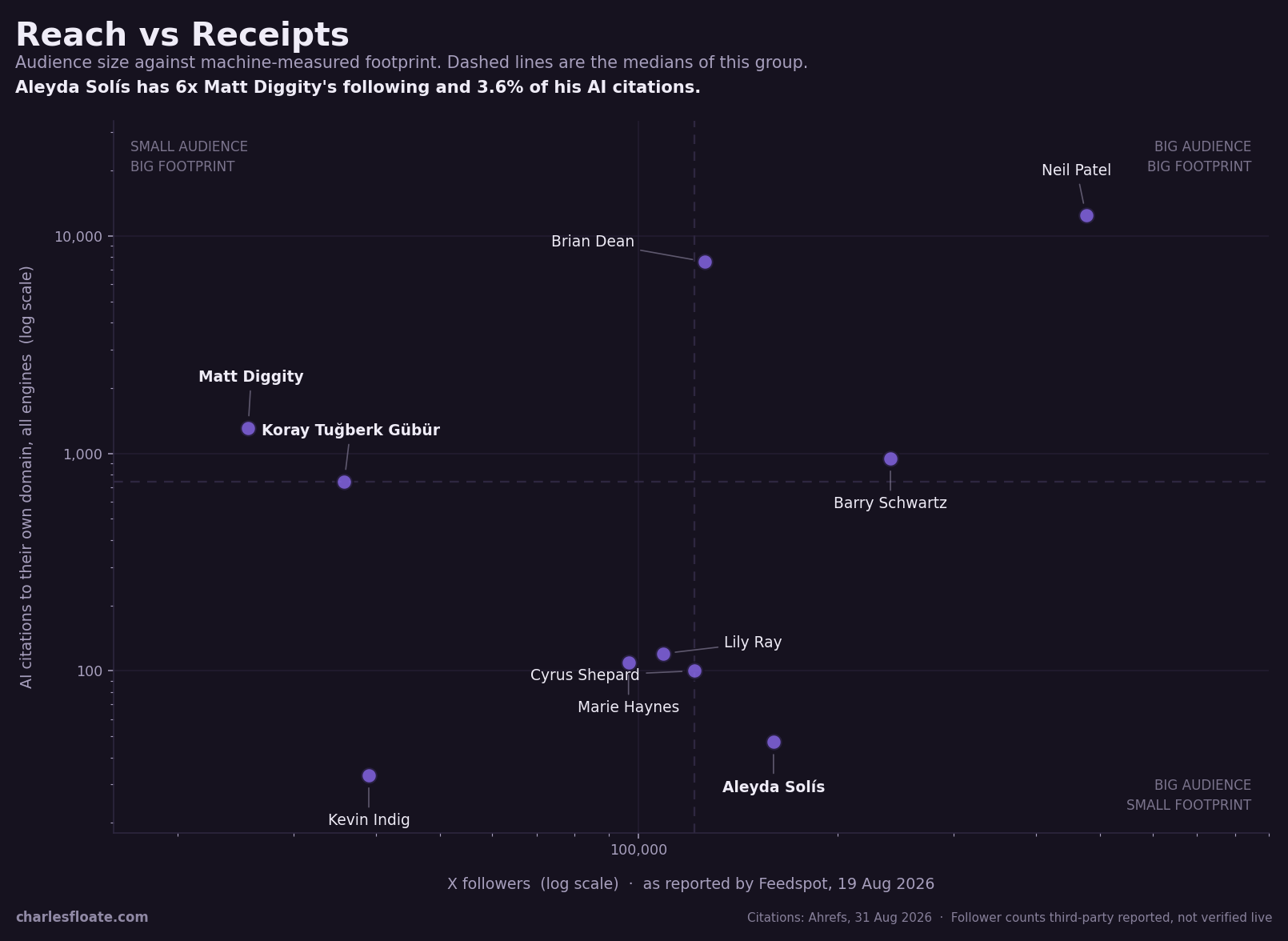
If reach and footprint tracked each other, the dots would form a diagonal. They form a cloud.
Matt Diggity and Koray Tuğberk Gübür sit in the top-left with the smallest followings on the chart and the largest citation counts of anyone on it besides the two content operations. Aleyda Solís, Cyrus Shepard, Lily Ray and Marie Haynes cluster in the bottom-right - large, genuinely earned audiences and citation counts in double digits.
Only Neil Patel and Brian Dean occupy the "both" corner, and both got there by running content operations at industrial scale rather than by being individually influential.
Matt Diggity, Koray Tuğberk Gübür. The engines quote them constantly and comparatively few humans follow them. If you are picking who to learn structure from, this is the quadrant. Both write in formats machines lift: tested comparisons, definitions, ranked tables.
Neil Patel, Brian Dean. Both, at scale. Also both running large publishing operations rather than posting as individuals, so what you are following is a content machine with a face on it. Useful, rarely surprising.
Aleyda Solís, Cyrus Shepard, Lily Ray, Marie Haynes, Barry Schwartz. Real expertise, real audiences, and their work lives in newsletters, agency blogs and X threads rather than in a crawlable archive. Follow all of them. Just do not confuse the follower number with a measurement of anything.
Mostly people early in building either one - and, on the original Feedspot list, a man with 865 followers ranked above everybody, and a man who died in 2022 ranked thirteenth.
| Name | X followers | AI citations | Organic traffic/mo | Citations per 1k followers |
|---|---|---|---|---|
| Neil Patel | 476,000 | 12,438 | 347,828 | 26.1 |
| Barry Schwartz | 240,600 | 946 | 21,696 | 3.9 |
| Aleyda Solís | 160,000 | 47 | 1,252 | 0.3 |
| Brian Dean | 125,900 | 7,619 | 319,747 | 60.5 |
| Cyrus Shepard | 121,400 | 100 | 1,670 | 0.8 |
| Lily Ray | 108,800 | 120 | 5,626 | 1.1 |
| Marie Haynes | 96,500 | 109 | 1,340 | 1.1 |
| Kevin Indig | 39,000 | 33 | 843 | 0.8 |
| Koray Tuğberk Gübür | 35,800 | 741 | 1,625 | 20.7 |
| Matt Diggity | 25,600 | 1,307 | 653 | 51.1 |
Genuine answer, no scoring theatre, because "follow" is a human decision and the chart above was never going to make it for you.
Notice that six of those eight have low citation counts. The chart tells you something real about content structure and nothing at all about whether a person is worth your attention. Both statements are true at once and this is the part most listicles get wrong in one direction or the other.
Both numbers maxed, and neither tells you much about Neil Patel the practitioner. He runs a global agency and a content operation publishing at a volume no individual can match, and 1,902 distinct cited pages is what that looks like from the outside. Follow for distribution lessons. Do not follow for technique.
The most honest profile on the table. Big audience, big citation count, 21,696 organic visits and 499 distinct cited pages, all of it earned by publishing search news every single day since 2003. The 3.9 citations per thousand followers is low only because his following is enormous.
If you unfollowed everyone in this industry except one person, it should be him, and that has been true for twenty years.
The starkest gap on the chart, and the clearest demonstration that this measurement has a blind spot rather than that Aleyda has a problem.
SEOFOMO goes out to a vast list every week and is probably the highest-signal free thing in the industry. Her AI search curriculum is good and she gives it away. None of that lives on aleydasolis.com in a form an engine can quote, so the number reads 47.
The strategic version of this: if your work lives in a newsletter, the machines that increasingly mediate discovery cannot see any of it. That was a fine trade in 2022. It is a real question now, and it applies to a lot more people than her.
60.5 citations per thousand followers, the highest number on the table, and the one I would trust least. Backlinko was sold to Semrush in 2022; Dean moved to Exploding Topics, which Semrush also acquired in 2024. The archive keeps being cited by a domain he no longer runs. The ratio is high because the numerator belongs to an asset he no longer runs.
A useful reminder that these metrics attach to domains, and domains change hands.
Runs some of the largest-sample ranking factor studies anyone publishes, which is exactly the kind of work that ought to get cited constantly. It gets cited 100 times across 29 pages.
Best guess at why: the studies land as one big annual asset rather than a continuously extended archive, and much of the discussion happens on X rather than on zyppy.com.
The best working read on E-E-A-T and on how AI Overviews actually pick their sources, and she publishes it constantly. The citation count is measured against amsive.com, an agency domain with many contributors, which is not really her personal footprint at all.
Read as a caveat on the method rather than a finding about her.
Has been writing about quality systems and how Google decides what to trust for longer than most people have been in the industry, and moved onto AI search early rather than late. 36 cited pages off a site doing 1,340 visits a month is a respectable machine footprint for a one-person operation.
Growth Memo is one of the few places doing genuine quantitative work on how LLM traffic behaves, and it is a newsletter. Same structural issue as Aleyda, same 0.8 citations per thousand followers as Cyrus, same conclusion: the measurement cannot see newsletters and an increasing share of the industry's best thinking now lives inside them.
Second-smallest audience on the chart, and more citations than everyone on it except Diggity and the two content operations. 266 of those are Perplexity, second only to Matt Diggity in the wider set of 33.
He writes enormous, structurally rigorous pieces about semantics and topical authority that a lot of people find hard to read. Machines do not find them hard to read at all, which is either a lesson about content structure or the single best argument for writing clearly that anyone has ever accidentally produced.
Smallest audience on the chart, largest citation count of anyone on it who is not a content operation, and 51.1 citations per thousand followers.
He does not post about AI SEO. He built a decade-deep archive of tested affiliate tactics, ranked tool comparisons and definition pages, and the engines treat it as a reference work. His Google traffic fell 98.9% over the same period - 53,260 monthly visits in November 2023, 572 now - which is the part nobody selling you an AI visibility course will mention.
I did not make the follower table. My audience is a fraction of the people on it and I have been doing this for eighteen years, which should tell you exactly how much correlation there is between tenure, competence and follower count.
What I do have is 118 AI citations on a DR 30 site, which puts me 22nd of 33 on the citation league table and mid-table on the receipts scoreboard. Those pages have my full numbers next to everyone else's.
If the useful half of this page was the bit about which content structures the engines actually quote, that is most of what we do inside. Weekly live call, the full stack, and the tests that do not go on the blog. Paid, operators only.
By X following, the largest are Danny Sullivan (509.2K), Neil Patel (476K), Barry Schwartz (240.6K), Aleyda Solís (160K) and Brian Dean (125.9K), per Feedspot as of 19 August 2026. By measurable footprint - AI citations to their own domain - the order changes almost completely, with Matt Diggity and Koray Tuğberk Gübür overtaking people with six times their audience.
Mostly no. The largest SEO influencer ranking in Google currently places an account with 865 followers at number one, above one with 476,000, and lists Bill Slawski at thirteen despite his death in 2022 - on a page last modified 19 August 2026. Treat these lists as a discovery tool and verify anything you plan to act on.
The relationship is weak. In this sample the person with the fewest followers has the highest citation count of anyone who is not a content operation, and the person with the third-largest following has the second-lowest citation count on the chart. Followers measure how good someone is at building an audience, which is a real and valuable skill and a different one.
Barry Schwartz for daily news, Aleyda Solís' SEOFOMO newsletter for the weekly round-up, Glenn Gabe when an algorithm update lands, and Lily Ray for quality and AI Overview work. All free, all high signal, none of them requiring you to buy anything.
Because they publish on platforms rather than to their own domain. Newsletters, LinkedIn posts, X threads and conference talks are invisible to a tool measuring website citations. It is a limitation of the measurement, not a judgement on the person - though it is also becoming a real strategic problem for anyone who wants to be quoted by machines.
P.S. - Screenshot the Feedspot list before you share this. If they finally fix the Slawski row after four years, I would like there to be a record.
Follower counts as reported by Feedspot, published 19 August 2026, not independently verified. AI citations and organic traffic from the Ahrefs API, pulled 31 August 2026, counted across ChatGPT, Perplexity, Gemini, Google AI Overviews, Google AI Mode, Copilot and Grok. Last updated 31 August 2026.