
I run a paid AI SEO community. It costs money, I want you in it, and that is a reason to distrust anything I say about the people who compete with me for your attention.
So I did not score this list on opinion. I scored it on one number that neither I nor anyone on this page controls: how many times the AI engines actually cite their website. I pulled it for all 33 of them on the same day, from the same tool, and I published my own number alongside theirs. I come 22nd.
Everybody selling AI SEO in 2026 has the same pitch. The engines are the new search. Get cited or die. Here is my framework, here is my course, here is my $2,000 audit.
Almost nobody selling it has bothered to check whether the engines cite them.
So I checked. Thirty-three names. Every primary domain run through Ahrefs on 31 August 2026, counting citations across ChatGPT, Perplexity, Gemini, Google AI Overviews, Google AI Mode, Copilot and Grok. No prompt sets I designed, no cherry-picked queries, no vendor's own dashboard. One tool, one day, same method for everyone including me.
The results are not what the conference lineups would have you expect.
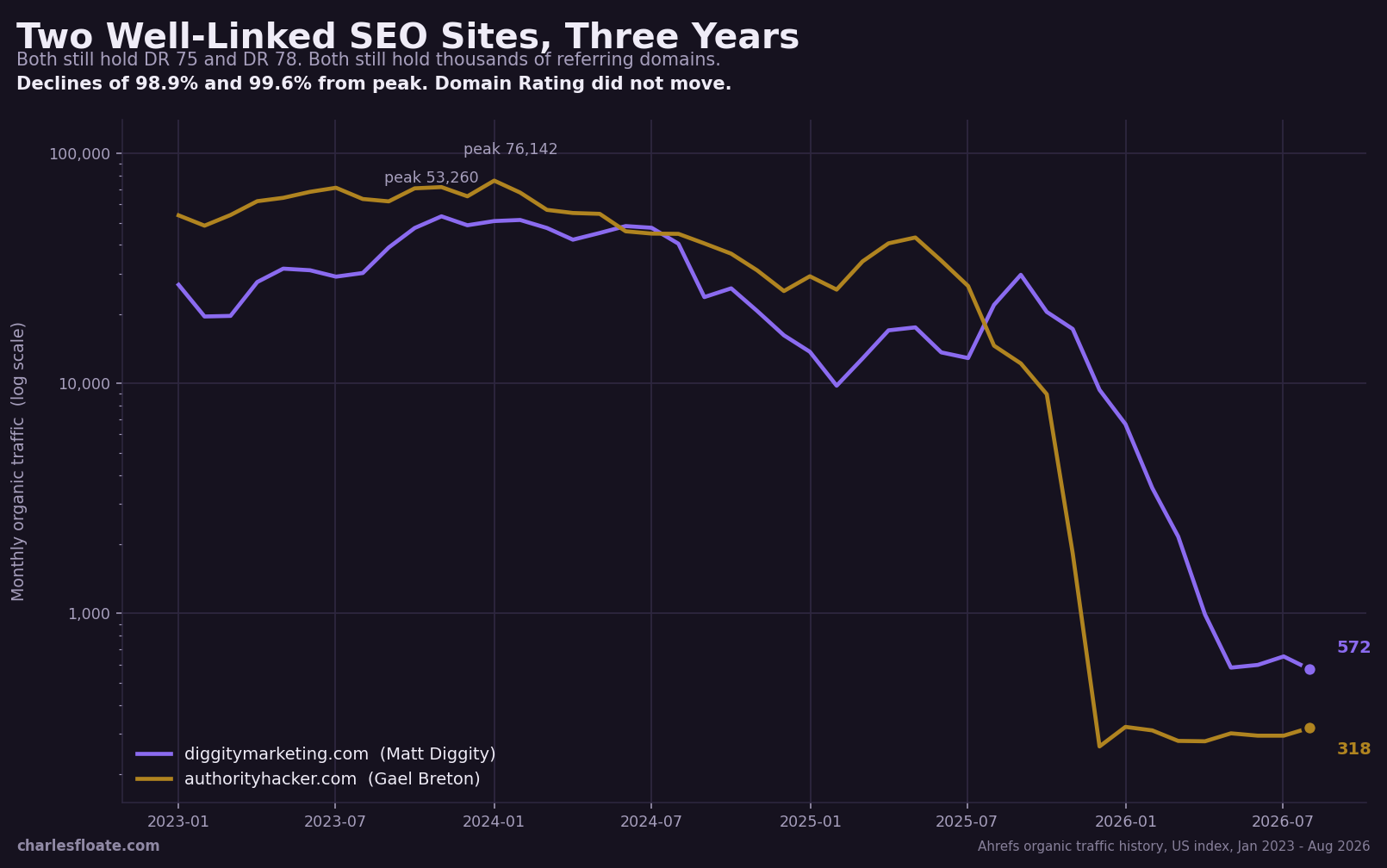
Matt Diggity's site pulls 653 organic visits a month. That is not a typo and it is not a small site - diggitymarketing.com is DR 75 with 4,411 referring domains. It peaked at 53,260 monthly visits in November 2023 and has fallen every quarter since - 9,376 last December, 989 in April, 572 this month. A 98.9% decline from peak, verified against Ahrefs' traffic history.
It has also been cited by AI engines 1,307 times across 199 pages.
That puts him fourth on raw citations, above Wil Reynolds, above Nathan Gotch, above Barry Schwartz, who has been publishing search news daily since 2003 and gets 21,696 organic visits a month to do it.
Diggity does not run an AI SEO course. He does not post GEO frameworks. He is an affiliate SEO who tests things and writes them up, and the engines have decided that is worth quoting two times for every single visit Google sends him.
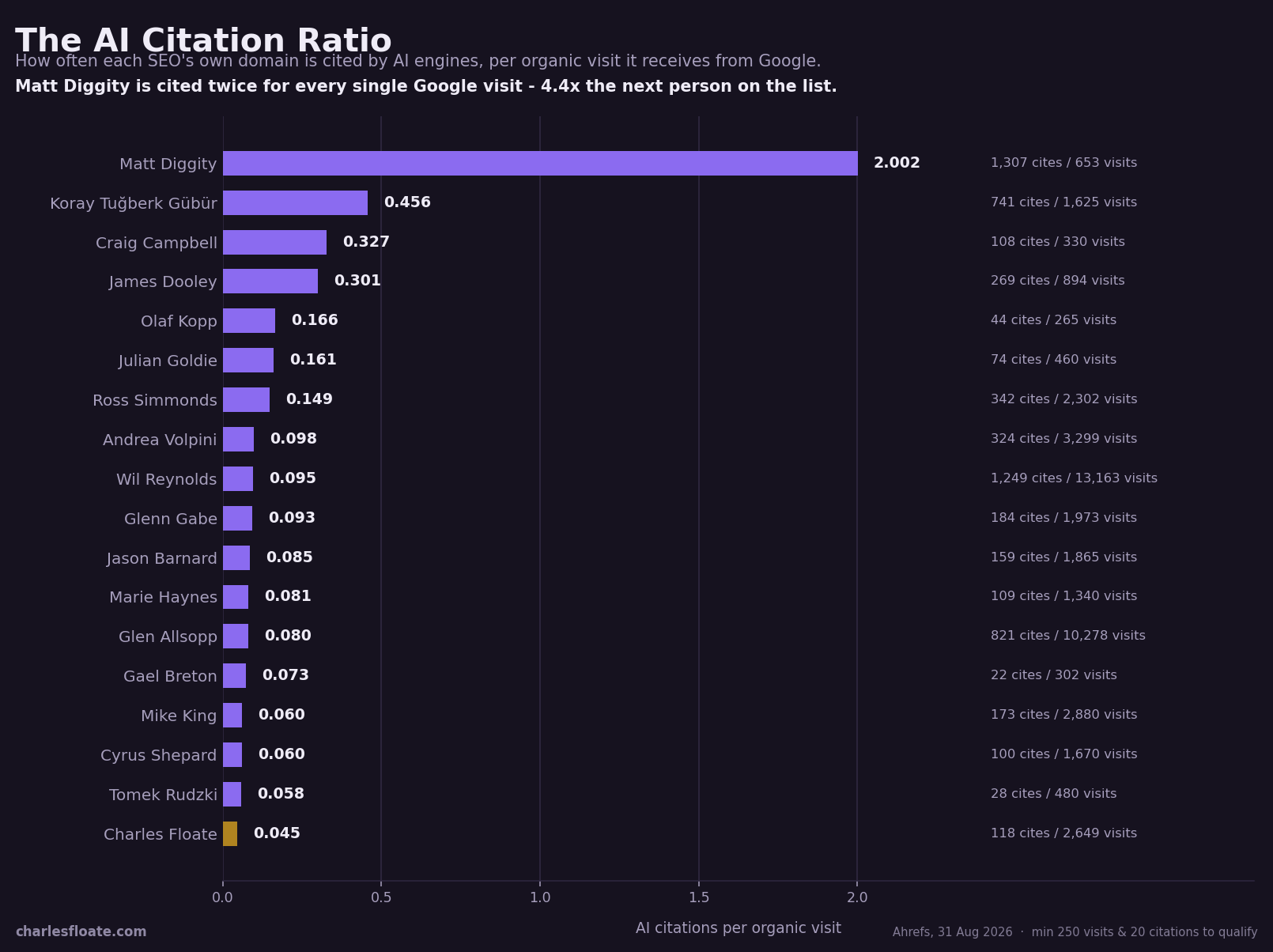
The number I keep coming back to: Diggity's citation ratio is 2.002 citations per organic visit. The next person on the list is at 0.456. That is a 4.4x gap between first and second on a list of 33 professionals, which in any other dataset would make you check your maths. I checked it three times.
Every listicle in this category scores on vibes and calls it methodology. Here is mine, in full, so you can disagree with the weightings instead of guessing at them.
The formula in one line:
Citation Score = 50·norm(log citations) + 30·(engines citing / 6) + 20·norm(log cited pages)
Three inputs, all measured, none of them my opinion. I deliberately left out a "do they publish their method" axis that I originally wanted, because I could not score it consistently across 33 people and a rubric with one subjective input in it is just an opinion wearing a lab coat.
Sorted by Citation Score. Per-engine columns come from Ahrefs separately and do not add up to the all-engine total, which is deduplicated - don't email me about the arithmetic. Grok returned zero for every single domain in the set, which is its own finding.
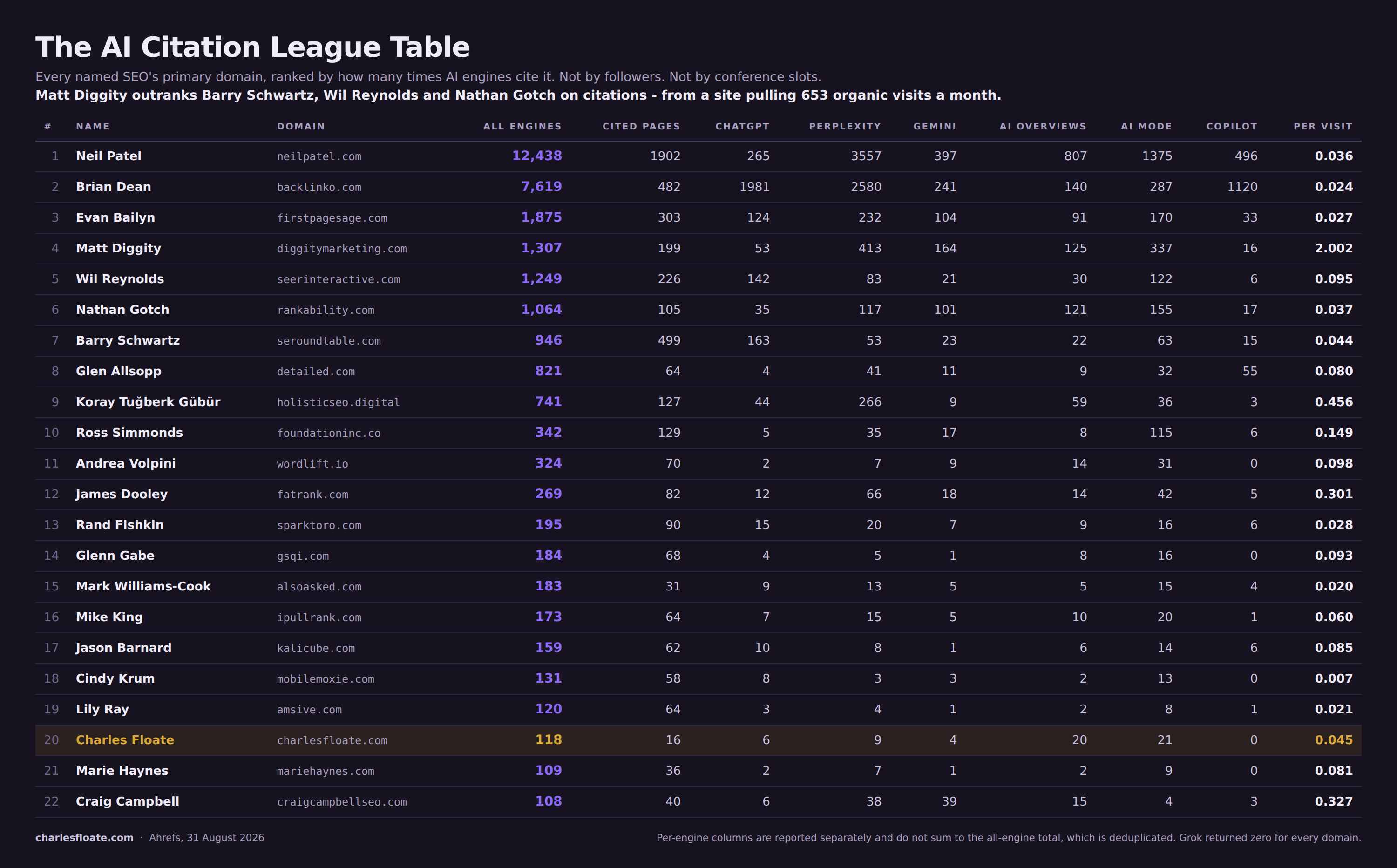
| # | Name | Domain | Score | All engines | Cited pages | Spread | ChatGPT | Perplexity | Gemini | AIO | AI Mode | Copilot | Per visit |
|---|---|---|---|---|---|---|---|---|---|---|---|---|---|
| 1 | Neil Patel | neilpatel.com | 100.0 | 12,438 | 1902 | 6/6 | 265 | 3557 | 397 | 807 | 1375 | 496 | 0.036 |
| 2 | Brian Dean | backlinko.com | 92.3 | 7,619 | 482 | 6/6 | 1981 | 2580 | 241 | 140 | 287 | 1120 | 0.024 |
| 3 | Evan Bailyn | firstpagesage.com | 81.7 | 1,875 | 303 | 6/6 | 124 | 232 | 104 | 91 | 170 | 33 | 0.027 |
| 4 | Barry Schwartz | seroundtable.com | 79.0 | 946 | 499 | 6/6 | 163 | 53 | 23 | 22 | 63 | 15 | 0.044 |
| 5 | Wil Reynolds | seerinteractive.com | 78.2 | 1,249 | 226 | 6/6 | 142 | 83 | 21 | 30 | 122 | 6 | 0.095 |
| 6 | Matt Diggity | diggitymarketing.com | 78.0 | 1,307 | 199 | 6/6 | 53 | 413 | 164 | 125 | 337 | 16 | 2.002 |
| 7 | Nathan Gotch | rankability.com | 74.6 | 1,064 | 105 | 6/6 | 35 | 117 | 101 | 121 | 155 | 17 | 0.037 |
| 8 | Koray Tuğberk Gübür | holisticseo.digital | 72.9 | 741 | 127 | 6/6 | 44 | 266 | 9 | 59 | 36 | 3 | 0.456 |
| 9 | Glen Allsopp | detailed.com | 71.3 | 821 | 64 | 6/6 | 4 | 41 | 11 | 9 | 32 | 55 | 0.080 |
| 10 | Ross Simmonds | foundationinc.co | 68.0 | 342 | 129 | 6/6 | 5 | 35 | 17 | 8 | 115 | 6 | 0.149 |
| 11 | James Dooley | fatrank.com | 65.0 | 269 | 82 | 6/6 | 12 | 66 | 18 | 14 | 42 | 5 | 0.301 |
| 12 | Rand Fishkin | sparktoro.com | 63.2 | 195 | 90 | 6/6 | 15 | 20 | 7 | 9 | 16 | 6 | 0.028 |
| 13 | Mike King | ipullrank.com | 61.3 | 173 | 64 | 6/6 | 7 | 15 | 5 | 10 | 20 | 1 | 0.060 |
| 14 | Jason Barnard | kalicube.com | 60.7 | 159 | 62 | 6/6 | 10 | 8 | 1 | 6 | 14 | 6 | 0.085 |
| 15 | Andrea Volpini | wordlift.io | 60.6 | 324 | 70 | 5/6 | 2 | 7 | 9 | 14 | 31 | 0 | 0.098 |
| 16 | Mark Williams-Cook | alsoasked.com | 59.3 | 183 | 31 | 6/6 | 9 | 13 | 5 | 5 | 15 | 4 | 0.020 |
| 17 | Lily Ray | amsive.com | 59.0 | 120 | 64 | 6/6 | 3 | 4 | 1 | 2 | 8 | 1 | 0.021 |
| 18 | Glenn Gabe | gsqi.com | 56.9 | 184 | 68 | 5/6 | 4 | 5 | 1 | 8 | 16 | 0 | 0.093 |
| 19 | Craig Campbell | craigcampbellseo.com | 56.8 | 108 | 40 | 6/6 | 6 | 38 | 39 | 15 | 4 | 3 | 0.327 |
| 20 | Cindy Krum | mobilemoxie.com | 54.2 | 131 | 58 | 5/6 | 8 | 3 | 3 | 2 | 13 | 0 | 0.007 |
| 21 | Marie Haynes | mariehaynes.com | 51.5 | 109 | 36 | 5/6 | 2 | 7 | 1 | 2 | 9 | 0 | 0.081 |
| 22 | Charles Floate | charlesfloate.com | 49.4 | 118 | 16 | 5/6 | 6 | 9 | 4 | 20 | 21 | 0 | 0.045 |
| 23 | Cyrus Shepard | zyppy.com | 45.3 | 100 | 29 | 4/6 | 1 | 4 | 0 | 2 | 8 | 0 | 0.060 |
| 24 | Julian Goldie | juliangoldie.com | 44.5 | 74 | 41 | 4/6 | 0 | 17 | 9 | 7 | 22 | 0 | 0.161 |
| 25 | Olaf Kopp | kopp-online-marketing.com | 43.7 | 44 | 19 | 5/6 | 2 | 4 | 1 | 2 | 4 | 0 | 0.166 |
| 26 | Aleyda Solís | aleydasolis.com | 35.0 | 47 | 25 | 3/6 | 7 | 2 | 0 | 0 | 3 | 0 | 0.038 |
| 27 | Kevin Indig | growth-memo.com | 31.8 | 33 | 18 | 3/6 | 0 | 1 | 0 | 2 | 6 | 0 | 0.039 |
| 28 | Tomek Rudzki | ziptie.dev | 31.4 | 28 | 22 | 3/6 | 3 | 5 | 0 | 0 | 8 | 0 | 0.058 |
| 29 | Kyle Roof | pageoptimizer.pro | 29.4 | 24 | 16 | 3/6 | 1 | 22 | 1 | 0 | 0 | 0 | 0.010 |
| 30 | Metehan Yeşilyurt | metehan.ai | 22.6 | 14 | 5 | 3/6 | 2 | 6 | 0 | 0 | 4 | 0 | n/a |
| 31 | Gael Breton | authorityhacker.com | 21.7 | 22 | 8 | 2/6 | 0 | 18 | 0 | 0 | 2 | 0 | 0.073 |
| 32 | Malte Landwehr | peec.ai | 21.0 | 9 | 7 | 3/6 | 2 | 3 | 0 | 0 | 2 | 0 | 0.004 |
| 33 | Dan Petrovic | dejanmarketing.com | 5.0 | 4 | 4 | 1/6 | 0 | 0 | 0 | 0 | 1 | 0 | 0.333 |
Raw citations reward whoever publishes most. That is why Neil Patel is first and it tells you nothing you can use.
The interesting number is citations divided by organic traffic. It asks: is this domain being pulled into AI answers beyond what its Google performance would predict? A ratio near zero means the engines find you exactly as often as Google does. A ratio above 1 means something else is going on.
Only one person in the whole set is above 1. He is at 2.
| Rank | Name | Ratio | What it probably means |
|---|---|---|---|
| 1 | Matt Diggity | 2.002 | Deep affiliate-review archive that engines treat as a reference. Also a collapsed traffic denominator - see the caveat below. |
| 2 | Koray Tuğberk Gübür | 0.456 | Semantic and topical-authority writing is exactly the shape a retrieval system wants. 266 of his 741 are Perplexity. |
| 3 | Craig Campbell | 0.327 | Enormous back-catalogue of opinionated posts on a low-traffic domain. |
| 4 | James Dooley | 0.301 | FatRank is a definitions-and-lists site. Definitions get quoted. |
| 5 | Olaf Kopp | 0.166 | Long-form German-language LLMO research, tiny English traffic. |
| 6 | Julian Goldie | 0.161 | High-volume AI SEO content aimed squarely at the queries engines answer. |
| 7 | Ross Simmonds | 0.149 | Distribution-first content. 115 of his citations are Google AI Mode alone. |
The pattern nobody wants to say out loud: four of the top seven on this ratio are independent affiliate and lead-gen operators, not the research names. The people who spent 2025 and 2026 explaining AI search on stage are mostly in the bottom half. Whatever the engines are rewarding, it is not thought leadership about the engines.
Plot the two against each other and the relationship falls apart almost immediately.
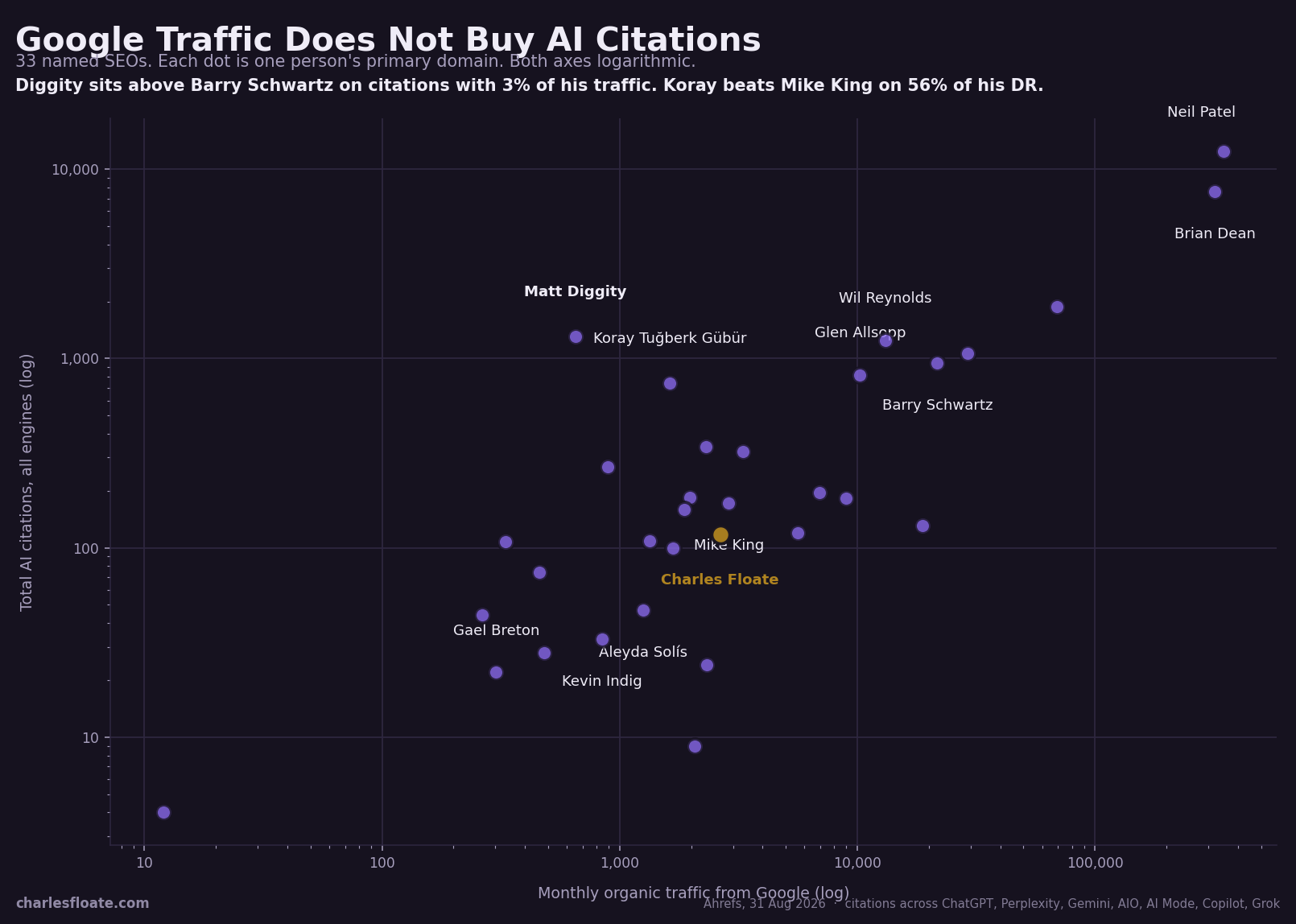
Look at the middle of that chart. Between roughly 1,000 and 10,000 monthly visits sit people with 4 citations and people with 1,307. Same traffic band, three orders of magnitude apart on citations.
Some of that is topic. A site about entity SEO gets cited when someone asks an engine about entity SEO. Some of it is format - definitions, lists and comparison tables get lifted, essays do not. And some of it is that the engines built their reference sets at different times and have not caught up.
What none of it is: a reward for ranking well in Google. If you are pitching AI SEO as "do good SEO and the citations follow", this chart is the problem with that pitch.
The most AI-cited domain per visit in the entire set, by more than four times, from a man who has never sold an AI SEO product. Diggity built an affiliate SEO archive over a decade - tool reviews, tested tactics, ranked comparisons - and that archive turns out to be exactly the shape a retrieval system reaches for.
The honest caveat: a ratio has two halves. His citations are genuinely high in absolute terms (fourth overall), but 653 visits is 1.1% of what this domain did in November 2023. Part of that 2.002 ratio is citations rising. Part of it is a 98.9% traffic decline flattering the denominator. I cannot weight the two from outside, so I am telling you both readings and showing you the traffic curve below.
Why he's worth watching anyway: even on raw citations he beats Barry Schwartz, and Schwartz publishes multiple times a day.
The lowest DR in the top ten and second on the ratio. Koray has spent years writing enormous, structurally dense pieces on semantics, topical authority and entity relationships, and the engines quote him constantly - 266 Perplexity citations, second only to Matt Diggity's 413 among individuals.
If you want the single clearest argument that content structure beats domain authority for AI retrieval, it is this row. He is DR 56 against Mike King's DR 75, has roughly a quarter of the referring domains, and takes 4.3x the citations.
People find his writing hard going. That appears to be irrelevant to machines.
Fifth on raw citations, and the highest-scoring agency domain in the set that is built on published research rather than publishing volume. Seer publishes its research rather than gating it, including large-scale work on how LLMs respond across hundreds of thousands of prompts, and 226 distinct cited pages is the signature of a system rather than one lucky asset.
Middling on the ratio because Seer also still ranks properly in Google. That is not a criticism. It is what a healthy site looks like.
16th. I expected top five and I was wrong, so here is the number rather than the number I expected.
King did more than anyone to make the Google leak legible and his relevance engineering work is the most technically serious thing being published in this space. The citation count does not reflect that, and I think the reason is format: his best work lands as conference talks, long PDFs and posts that other people then summarise. The engines cite the summarisers.
That is a genuinely uncomfortable finding for anyone who believes AI citation tracks expertise. It tracks quotable, indexed, plain-HTML text. Those are different things.
Last on this list and one of the two or three people in the industry I would actually take a research question to.
Petrovic does mechanistic interpretability work on search models - the kind of thing where he trains something himself to find out how retrieval behaves. Almost none of it lives on dejanmarketing.com in a form an engine can lift. He posts findings to LinkedIn and X, publishes experiments as threads, and lets the site sit.
I have excluded him from the ratio because 12 organic visits is not a denominator, it is a rounding error, and dividing by it would produce a meaningless number that flattered him. Rating him 33rd on AI citations would tell you he is the worst AI SEO in the field. He is not. It tells you he does not publish to his own domain, which is a completely different sentence.
This is the clearest example on the page of why a single metric is not a verdict.
25th, and the gap between her standing in the industry and her citation count is the widest on the page. She runs SEOFOMO, she has taught more working SEOs than most universities, and her AI search curriculum is genuinely good.
Her problem is architectural. The newsletter is the product and the newsletter does not live in a crawlable archive the engines can quote. Same failure mode as Mike King, different cause.
Sixth on citations and the most balanced profile in the top ten - real Google traffic, real citations, spread across every engine including 121 AI Overviews and 101 Gemini. He is also the only person here with an AI SEO book coming from a mainstream publisher, which will do more for his entity than any of this.
Grouping these two because they have been making the same argument for longer than anyone - that knowledge graphs and entity resolution are the substrate under all of this - and both are now being quietly vindicated by engines that run on exactly that.
Neither scores spectacularly. Both score consistently across engines, which on this rubric is worth more than a Perplexity spike.
Malte Landwehr (CPO at Peec AI), Tomek Rudzki and Metehan Yeşilyurt are all doing serious measurement work and all three sit near the bottom of this table.
I want to be fair about why: these are young domains attached to young companies, and a tool's marketing site is not the same asset as a decade-old blog. Rudzki's query fan-out research is among the best public work on how AI search retrieves.
But if you are about to pay one of these platforms to tell you how visible you are in AI search, you are entitled to know that the platform itself is currently less visible than a man who reviews affiliate tools from Chiang Mai.
I would rather publish the holes than have you find them.
If you think a number here is wrong, the underlying pulls are all reproducible in Ahrefs in about ten minutes. Go and check. Then tell me and I will change it, with a note saying what changed and why.
I appear on the table at 22 because leaving myself off would be the exact dishonesty this page exists to complain about. 118 citations across 16 pages, ratio 0.045. Mid-table on a DR 30 site, which is the lowest domain rating in the entire set by 20 points.
I am not going to score my own community on my own rubric. I will tell you what it is and let you decide.
A paid community where the AI search work gets tested before it gets taught. Weekly live call, the full prompt and repo stack, and the experiments I cannot publish here - including the live PR-to-citation test running across 13 vendors. It is not cheap and it is not for beginners.
If that is not what you want, the honest alternative is: read Koray's back catalogue, follow Seer's published research, and re-run this exact Ahrefs pull on your own domain every month. That costs nothing and gets you 80% of the way.
On raw AI citations to their own domain, Neil Patel (12,438) and Brian Dean (7,619), but both are large content operations rather than practitioners. Among individual practitioners, Matt Diggity leads on citations per organic visit at 2.002, and Koray Tuğberk Gübür leads among people who actually specialise in semantic and AI search work, at 0.456. All figures from Ahrefs, 31 August 2026.
Ask whether the engines cite them. Run their domain through Ahrefs' AI citation report and compare the citation count to their organic traffic. It is not a complete measure - it misses anyone who publishes mainly on LinkedIn or in a newsletter - but it is the only measure in this field that the person being measured does not control.
Three reasons, in order of how often they apply: their best work lives off their own domain (LinkedIn, newsletters, conference talks); their content is written as essays rather than as liftable definitions, lists and comparisons; or their site is new. Expertise and citation count are correlated far more weakly than the industry assumes.
Perplexity, comfortably. It out-cited ChatGPT on 27 of the 33 domains measured, and on some domains by more than 20x. If you are only tracking ChatGPT visibility you are watching the most conservative engine in the set.
Not reliably. In this dataset a DR 56 site (holisticseo.digital, 741 citations) out-cites a DR 75 site (ipullrank.com, 173) by more than 4x, and a DR 65 site with 1,116 referring domains returned 4 citations. Structure and format predict citation better than authority does.
If you already rank things, learn it - the mechanics are entity work, chunking and third-party mentions, and none of it is beyond a competent SEO. If you are hiring, ask the consultant for their own domain's citation count before you ask for their case studies. It takes them one minute to pull and it tells you whether they have done the thing they are selling.
P.S. - Every number on this page came out of the same tool on the same day, and I published my own alongside everyone else's. If someone selling you AI SEO won't do that for their own domain, you have learned something.
Data: Ahrefs API, 31 August 2026. Citations counted across ChatGPT, Perplexity, Gemini, Google AI Overviews, Google AI Mode, Copilot and Grok. Organic traffic and Domain Rating from the Ahrefs US index. Last updated 31 August 2026 - I re-run this quarterly and log what moved.